Architecture
Architecture
Overview
givenergy-modbus is a layered library for communicating with GivEnergy inverters and peripherals over Modbus TCP. It handles framing, PDU encoding/decoding, register caching, and data model construction, exposing a high-level async Client and a Plant data model to application code.
Physical topology
A GivEnergy installation exposes two network endpoints:
- Inverter gateway (port 8899) — the primary endpoint, using GivEnergy's proprietary transparent framing over TCP. All inverter-adjacent devices share this connection via Modbus device addresses (formerly known as slave addresses; Modbus.org adopted client/server terminology in 2020).
- GivEVC charger (port 502, separate IP, future) — a standard Modbus TCP device polled via a second connection.
graph LR
    app1(["givenergy-cli"])
    app2(["givenergy-hass"])
    app3(["GivTCP"])

    lib(["givenergy-modbus
    library"])

    subgraph conn["Network connections"]
        gw["Inverter gateway
        (Modbus TCP, port 8899)"]
        evc_tcp["EV Charger gateway
        (Modbus TCP, port 502)
        (future)"]
    end

    subgraph modbus_devices["Modbus devices (via gateway)"]
        inv["Inverter
        (addr 0x32)"]
        bat["LV Batteries
        (addr 0x32–0x37)"]
        bcu["HV BCU stacks
        (addr 0x70+)"]
        meter["Meters
        (addr 0x01–0x08)"]
        ems["Plant controller (EMS models only)
        (addr 0x11 / 0x32)"]
        gateway["Gateway (Gateway product)
        (addr 0x32)"]
    end

    evc(["EV Charger
    (future)"])

    app1 --> lib
    app2 --> lib
    app3 --> lib

    lib --> gw
    lib -.->|future| evc_tcp
    gw --> inv & bat & bcu & meter & ems & gateway
    evc_tcp -.-> evc
All devices except the EVC share a single TCP connection to the gateway. The EVC requires a second connection to a different host.
Software layers
graph TB
    subgraph app["Application layer"]
        user(["givenergy-hass\ngivenergy-cli\ncustom code"])
    end

    subgraph client["givenergy_modbus.client"]
        detect["detect()\ndiscover topology"]
        loadcfg["load_config()\nread HR banks"]
        refresh["refresh()\nread IR banks"]
        cmds["commands\nwrite operations"]
    end

    subgraph pdu["givenergy_modbus.pdu / .framer"]
        pdus["ReadHoldingRegisters\nReadInputRegisters\nReadMeterProduct\nWriteHoldingRegister"]
        framer["GivEnergy transparent\nframing over TCP"]
    end

    subgraph model["givenergy_modbus.model"]
        plant["Plant\nregister_caches · capabilities"]
        caps["PlantCapabilities\ndevice_type · inverter_address\nlv_battery_addresses · meter_addresses\nbcu_stacks · evc_host (future)"]

        subgraph devices["Device models (lazy accessors)"]
            sp["SinglePhaseInverter"]
            tp["ThreePhaseInverter"]
            battery["Battery (LV)"]
            hvstack["HvStack\nBcu + Bmu"]
            mtr["Meter + MeterProduct"]
            ems["Ems"]
            gw["GatewayV1 / GatewayV2"]
            evc["Evc (future)"]
        end

        subgraph reg["Register infrastructure"]
            cache["RegisterCache\ndict[HR|IR|MR → int]"]
            getter["RegisterGetter\nbounds · coherence · decode"]
            defn["RegisterDefinition\nconverters · min/max bounds"]
        end
    end

    user --> detect & loadcfg & refresh & cmds
    detect & loadcfg & refresh & cmds --> pdus
    pdus --> framer
    framer -->|"TCP"| user

    detect -->|"writes"| caps
    loadcfg & refresh -->|"updates"| cache
    plant --> caps
    plant --> cache
    cache --> getter --> defn
    getter -->|"decoded"| sp & tp & battery & hvstack & mtr & ems & gw & evc
Client lifecycle
client.connect()       establish TCP connection(s)
       │
client.detect()        read HR(0)/HR(21) to resolve model; probe peripherals
       │               → writes PlantCapabilities to plant.capabilities
       │
client.load_config()   fetch HR configuration banks (slots, targets, limits)
       │               extra banks dispatched per device type (three-phase,
       │               extended slots, EMS)
       │
       ╔══ polling loop ══════════════════════════════════════╗
       ║  client.refresh()   fast poll: IR measurement banks  ║
       ║                     extra banks per device type      ║
       ╚══════════════════════════════════════════════════════╝
       │
client.load_config()   re-read after any write to confirm the change landed
detect() is intentionally slow — a correct topology is more important than fast startup. It uses a two-tier timeout: full retries for known devices, short probe retries for speculative addresses (meters, batteries, BCU stacks) where absence is the common case.
Inside detect(): strategise / probe / derive
After resolving the model, detect() runs a loop over the peripheral steps (BCU, AIO, HV BMU, meters, LV batteries, LV BCU, EMS). Each step is split into three roles, separated by whether they touch the wire:
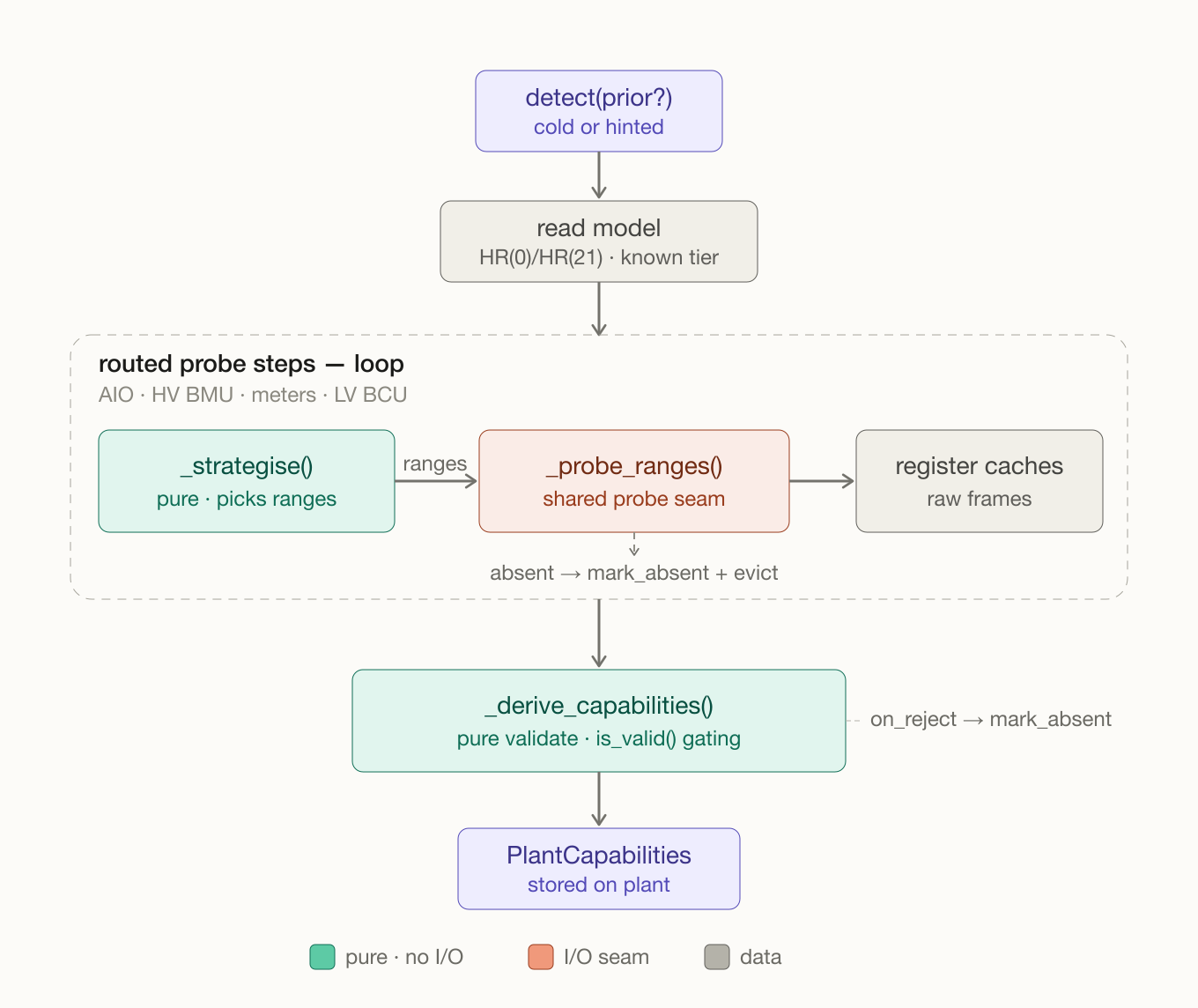
_strategise(caps, prior, step)— pure policy. Given the model and an optionalpriorhint, it returns theProbeRanges to read for that step. Cold (no hint) yields a broad candidate sweep; hinted restricts to the addressesprioralready knows. No I/O, so it is exhaustively unit-testable._probe_ranges(ranges)— the shared I/O seam for the_strategise-routed probe steps (AIO modules, HV BMUs, meters, LV BCU). It issues each read at its tier (fastprobe_timeoutfor speculative probes, fulltimeoutfor known devices) and, on a probe that does not answer, callsmark_absent()and evicts the stale cache entry._derive_capabilities(caches, prior, on_reject)— pure validation. It reads the now-populated register caches, applies each device'sis_valid()gate, and builds the authoritativePlantCapabilities. Rejections thread back throughon_rejecttomark_absent().
This split is what makes the offline Plant.from_caches() path possible (#268): _derive_capabilities is the same pure function whether the caches came from a live probe or a saved register dump.
Note
Several reads still touch the wire outside _probe_ranges: the initial model read, BCU stack discovery, LV-battery enumeration, and the EMS rollup cross-check (BCU and LV-battery probing carry the cold-start splice-guard re-probe, #233/#289). The loop above shows the shared-seam pattern that the AIO, HV-BMU, meter and LV-BCU steps follow — not every read in detect().
Why three functions
Before #345, detect() fanned out to a per-device-type helper for each peripheral, and every helper independently tangled all three concerns — pick candidates, probe, then validate-and-mutate caps:
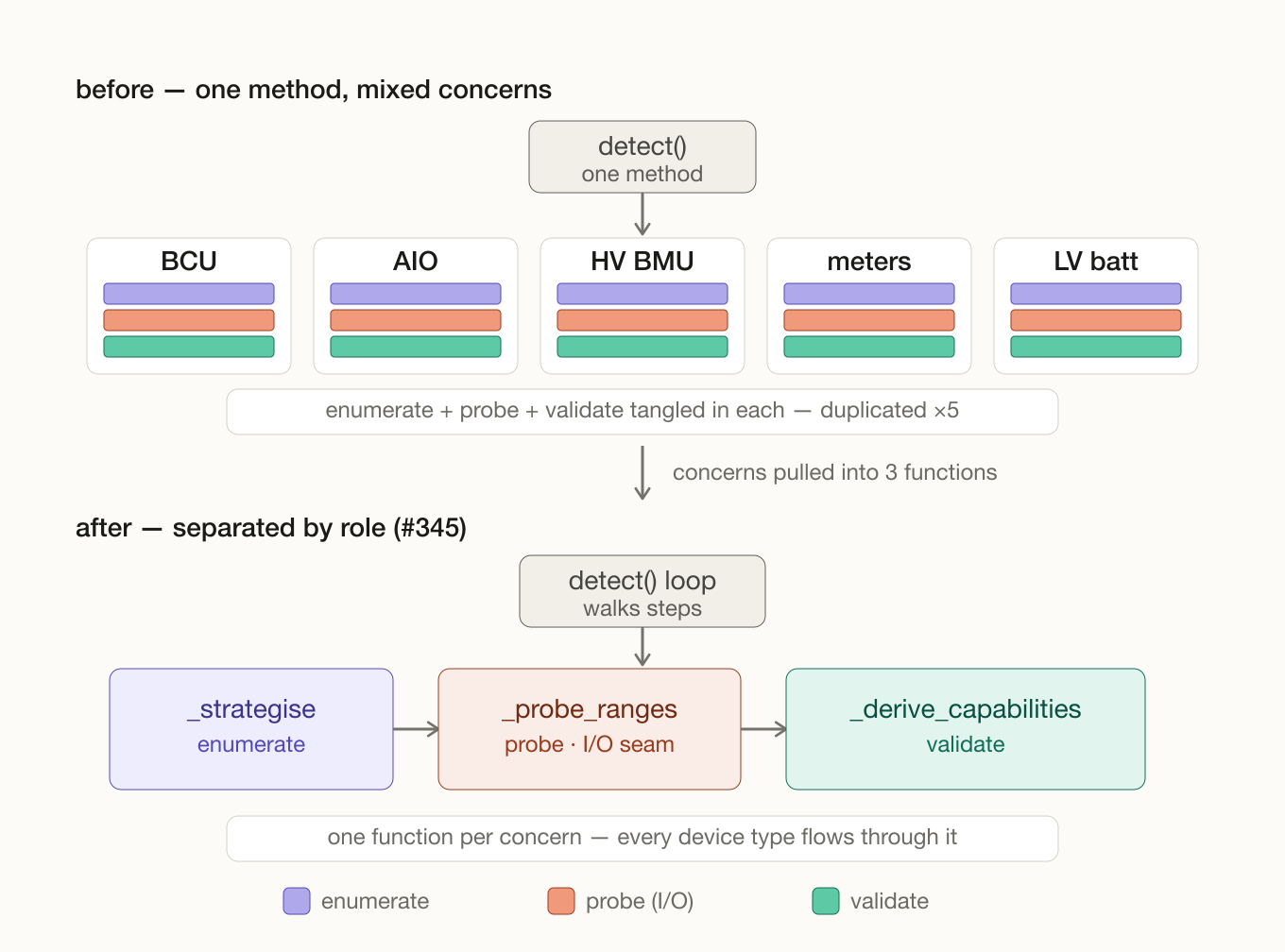
The refactor transposes that grid: instead of five helpers each doing all three jobs, there is one function per job. Candidate generation lives once (shared by _strategise and _derive_capabilities) and validation lives once in _derive_capabilities, both spanning every device type; the probe I/O routes through _probe_ranges for the AIO, HV-BMU, meter and LV-BCU steps. A change to a candidate range or a validation gate is now a one-site edit rather than a five-site sweep.
How refresh() decomposes
The polling path mirrors detect()'s split — pure policy decides what to read, a single seam does the I/O:
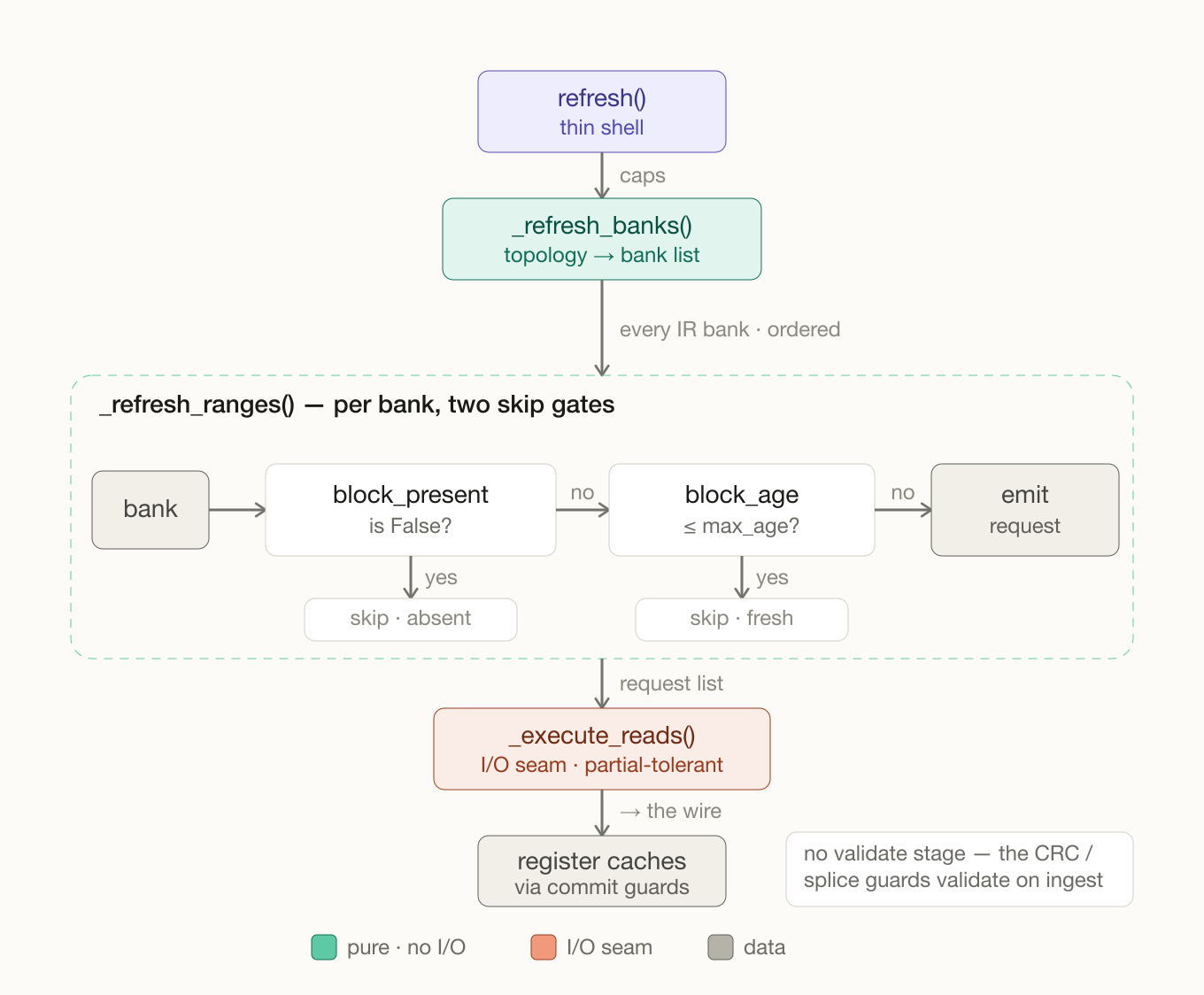
_refresh_banks(caps)— pure topology. TurnsPlantCapabilitiesinto the ordered list of IR banks the plant exposes (inverter measurement blocks, per-battery, per-meter, BCU / AIO / HV-BMU pages). No I/O, no policy._refresh_ranges(caps, max_age, plant)— pure policy. Walks the bank list and applies two skip gates per bank: drop it ifdetect()marked it absent (plant.block_present(...) is False, #268), then drop it ifmax_agesays it is still fresh (plant.block_age(...) <= max_age, #196/#207). Whatever survives becomes aReadInputRegistersRequest._execute_reads(...)— the I/O seam. Issues the batch and tolerates partial failure (RefreshPartiallySucceeded/RefreshFailed).
refresh() itself is a thin shell around these: check that capabilities exist, map the deprecated ir0_max_age onto max_age, then await self._execute_reads(_refresh_ranges(...)).
Unlike detect(), there is no validate stage. refresh() decides only what to ask for; whether to believe a response is the cache layer's call — the keep-last-good guards (CRC #255, sub-bus splice #256, bank holds) validate each frame as it commits. The skip-if-fresh gate also makes refresh() cooperative with the dongle fan-out: GivEnergy dongles echo responses to every connected client, so a bank another poller just refreshed can be left alone (#196).
A caveat on that fan-out, though: echoing to every connected client is not the same as tolerating several of them. How well a dongle copes with concurrent connections and polling load appears to vary by hardware generation, and we can't characterise it from inside the library. One newer-chipset All-In-One dongle (hass#95) idle-reaps the TCP connection roughly every ~10s even with only two clients polling at a fairly mild ~30s cadence — the client reconnects transparently each time and the fan-out resumes, so it stays functional, but "multiple clients at frequent poll rates just work" is not a guarantee the hardware makes uniformly. Treat the fan-out as an opportunistic optimisation, not a contract that concurrent access is free.
Plant data model
Plant is passive — it stores data, drives no I/O. Its two responsibilities are:
register_caches—dict[int, RegisterCache]keyed by Modbus device address, populated byClientas responses arrive.capabilities— aPlantCapabilitiesdataclass describing the topology discovered byClient.detect().
All plant properties are lazy decoders: they read from register_caches and construct the appropriate concrete model class, dispatching on capabilities.device_type where needed.
| Accessor | Returns | Condition |
|---|---|---|
plant.inverter |
SinglePhaseInverter \| ThreePhaseInverter |
always |
plant.batteries |
list[Battery] |
LV systems only |
plant.hv_stacks |
list[HvStack] |
HV systems only |
plant.meters |
dict[int, Meter] |
when meters detected |
plant.ems |
Ems \| None |
Model.EMS / EMS_COMMERCIAL only |
plant.gateway |
GatewayV1 \| GatewayV2 \| None |
Model.GATEWAY only |
plant.evc |
Evc \| None |
future |
Register infrastructure
Each device model is backed by a RegisterGetter subclass that holds a REGISTER_LUT — a dict mapping field names to RegisterDefinition instances. Each definition specifies:
- Converter(s) — how to decode raw
uint16register values (e.g.C.decidivides by 10,C.timeslotreconstructs aTimeSlot,C.bitfieldextracts bit ranges). - Post-converter — optional second-stage transform or enum lookup.
- Register address(es) — one or more
HR/IR/MRaddresses; multi-register fields (e.g.uint32, strings) list all constituent registers. - Bounds — optional
min/maxin real-world units (post-conversion), used to detect physically impossible values and log violations before committing a bank.
RegisterCache is a plain defaultdict[HR|IR|MR, int] — just storage. Coherence (serial-number validity) and bounds validation live on the RegisterGetter, applied by Plant._commit_bank as each bank arrives. Several classes of bad bank are already rejected outright: an invalid serial, a CRC failure, an all-zero dropout of a previously-populated bank, and a battery sub-bus splice. Bounds violations are the remaining exception — they're logged (at DEBUG) and the bank is still committed, pending the enforcement step tracked by a TODO in _commit_bank.
References
Protocol layering
The TCP surface this library talks to is two layers above the actual battery: library → TCP → dongle → internal serial → inverter → RS485 → BMS. The inverter caches BMS state and re-exposes it via the dongle's TCP server. This matters when interpreting failure modes — a "stuck" battery on TCP usually means a stale inverter-side cache, not necessarily a wedged BMS. See givenergy_modbus/framer.py's module docstring for the wire-format details and the cache-freeze / exception-origin caveats.
External
- open-giv/bms-analysis — authoritative reference for the RS485 BMS↔inverter dialect, including:
- The "absent device" response pattern that this library's
Client.detect()relies on for LV battery probing (zero-filled responses for unpopulated0x32..0x37slots, plus the0xF556 = -273.0 °Ctemperature sentinel that ourBatterybounds incidentally reject). - Static analysis of the BMS firmware confirming that the BMS Modbus dispatcher only implements FC=03/04/06; max register count per request is 128; CRC failures are silently dropped without an exception response.
- Capture tooling (
tools/serial_hexdump_logger.c,tools/parse_log.py) useful for paired RS485+TCP investigations of the sort discussed in #78.
- The "absent device" response pattern that this library's
- Modbus.org spec — the underlying wire protocol; GivEnergy's framing extends it with the
0x59590001magic header and the Transparent (0x02) function-code envelope.